
I want to start with a story that isn't mine to name.
A woman I know went through IVF. Anyone who has walked that road, or walked beside someone on it, knows how much it asks of you. The waiting. The appointments. The hope you try to hold carefully so it doesn't break.
At some point, she and I got to talking about food. Not as a fix, and not as a promise. Over the past 8 years, I've spoken with some mothers about what they eat and how it affected their journey, and as I shared those conversations with her, something shifted.
For her, it clicked: what's being put into our food might be messing with our bodies. Not the food itself, but everything that comes along with it.
Her words made me look harder at a question I think about every day as a farmer: not just what we eat, but what comes with it. The sprays on the field, the chemicals in the packaging, the things added along the way. Here is what the research actually says, the hopeful parts and the uncertain parts.
First, the honest part
Fertility is complicated, and it involves both partners. Age, health conditions, weight, smoking, alcohol and many other things play a part. About 1 in 6 adults experience infertility at some point (WHO, 2023), so if that's you, you are far from alone, and none of this is your fault.
Most of the studies below are observational. They can find patterns, but they can't prove that one thing causes another. Nothing here means one food, or one chemical, decides anyone's outcome.
Pesticide residues on produce
This is the one I care about most as a grower.
In a Harvard study of 325 women going through fertility treatment, those who ate the most fruits and vegetables with high pesticide residues had lower chances of pregnancy and live birth than those who ate the least. Eating more low-residue produce wasn't linked to worse results (Chiu et al., JAMA Internal Medicine, 2018).
Not every study agrees. A large study of couples trying to conceive on their own didn't find a clear link between high-residue produce and how quickly they conceived (Wesselink et al., Environment International, 2020). So the picture is still being filled in.
What we do know more firmly is that the way food is grown changes what ends up in our bodies. When families switched to an all-organic diet for just six days, the levels of many pesticides measured in their urine dropped sharply (Hyland et al., Environmental Research, 2019).
And please hear this: vegetables are not the problem. The concern is residues, not produce. Keep eating your greens.
Chemicals from packaging
Some chemicals can move from containers and wrappers into food, especially with heat or fat. Scientists call some of them endocrine disruptors, because they can interfere with the body's hormones (NIEHS).
- BPA, found in some can linings and hard plastics: among women going through IVF, higher BPA levels in urine were linked to more implantation failure (Ehrlich et al., Environmental Health Perspectives, 2012).
- Phthalates, used in some plastics and food processing equipment: higher levels of one common type were linked to fewer eggs retrieved and lower chances of pregnancy and live birth after IVF (Hauser et al., Environmental Health Perspectives, 2016).
- PFAS, the "forever chemicals" once common in grease-resistant food wrappers: the FDA says grease-proofing PFAS are no longer being sold for food packaging in the US (FDA). That's real progress.
Additives and heavily processed foods
- Artificial trans fats (listed as "partially hydrogenated oils") were linked to a higher risk of ovulation-related infertility in a large study of US nurses (Chavarro et al., American Journal of Clinical Nutrition, 2007).
- Sugary drinks consumed most days were linked to a lower chance of conceiving each cycle in a North American study of couples (Hatch et al., Epidemiology, 2018).
- Ultra-processed foods have been linked to poorer semen quality in men, a reminder that food matters for both partners (Valle-Hita et al., Human Reproduction Open, 2024).
- On the hopeful side, Mediterranean-style eating, built on vegetables, beans, whole grains, nuts and olive oil, has been linked to better semen quality in male partners of couples trying to conceive (Karayiannis et al., Human Reproduction, 2017).
Simple, calm steps
These aren't a treatment or a guarantee. They're small ways to lower what comes along with your food.
- Know where your produce comes from. Buy from local growers you can ask, and choose organic or low-residue options for what you eat most, if your budget allows.
- Wash and scrub fruits and vegetables well.
- Heat food in glass or ceramic, not plastic, and use a real mug for hot drinks.
- Choose fresh or dried beans and grains over canned when you can, or look for cans labeled BPA-free.
- Read labels for "partially hydrogenated oils" and long lists of additives, and lean toward whole foods.
- Swap sugary drinks for water, sparkling water with citrus, or herbal tea.
Please talk with your doctor
If you've been trying to conceive for a year, or for six months if you're 35 or older, it's a good idea to see a doctor or fertility specialist. Please talk with them before starting any supplement or making big changes to how you eat.
How we grow at Little Logan's Farm
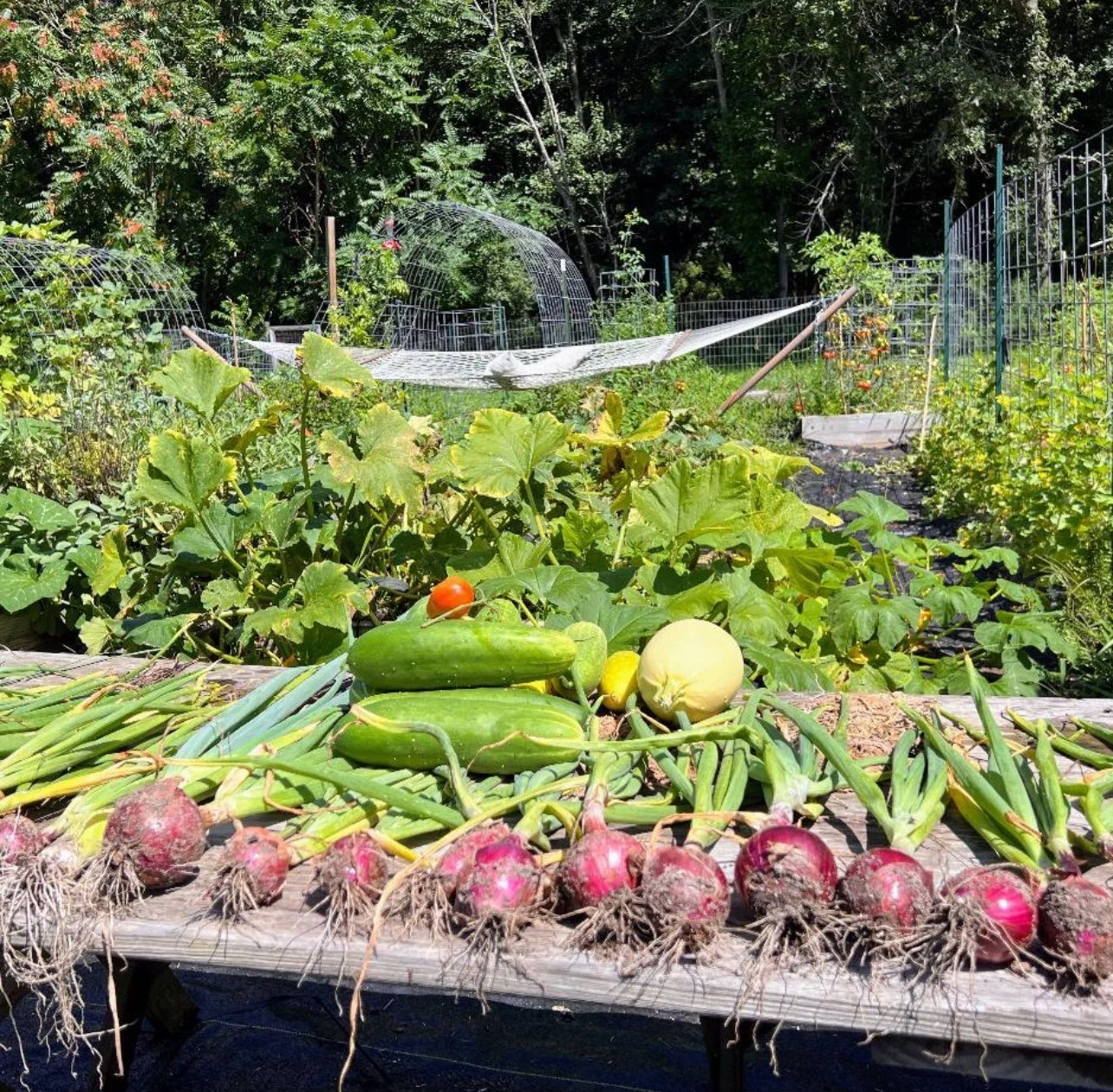
This is why we farm the way we do. At Little Logan's Farm in Gardiner, NY, we're Biocyclic Vegan certified. That means no synthetic pesticides and no animal inputs at any step. We feed the soil with plant-based compost and care, so you know exactly how your food was grown, and you can always ask us.
We offer a variety of teas, special picks, and varieties of seasonings, all from our farm, along with fresh seasonal vegetables through our CSA.
Our 2027 CSA is open. Weekly shares come in two sizes: a half share for $600 or a full share for $1,200. You can pick up at the farm in Gardiner, at Black Cat Bulk Goods in New Paltz, or in NYC at 9th Street Espresso and The Orchard Grocer.
Early-bird offer: take 10% off the half share when you pay in full by January 31, 2027, with code EARLYBIRD27.
Wherever you are on your own path, I hope you find moments of nourishment and calm along the way. And to the woman who let me share her story: thank you.
With love from the farm, Frances Gonzalez, Founder, Little Logan's Farm
This post is for general information only and isn't medical advice. Everyone's situation is different. Please talk with your doctor or a fertility specialist about your own health and any changes to your diet or supplements.
