
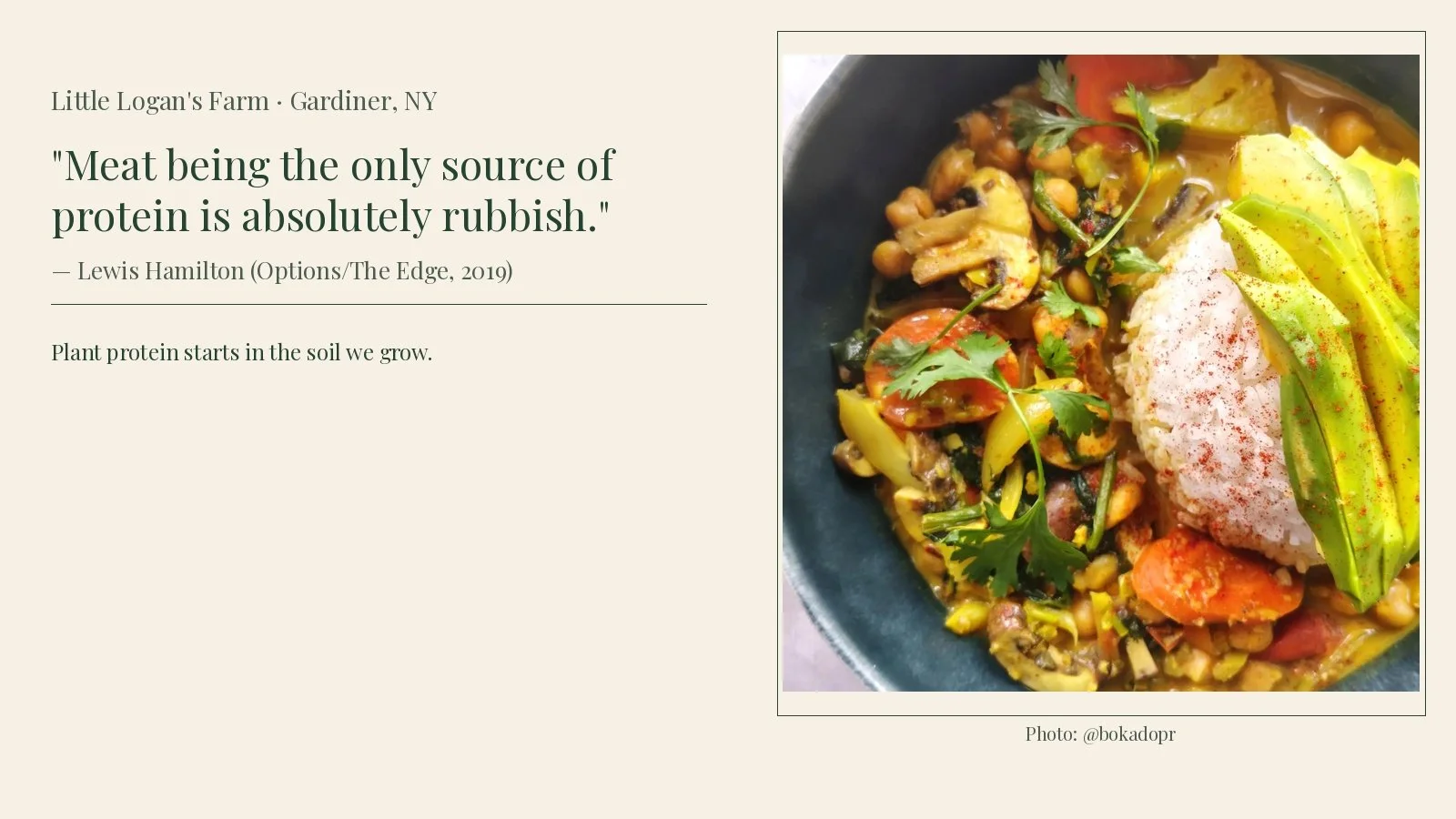
"Meat being the only source of protein is absolutely rubbish."
— Lewis Hamilton, Options / The Edge, November 2019
That's it. One plain sentence from a seven-time Formula 1 world champion. No lecture. Just a fact a lot of people still trip over.
Hamilton said it in an interview with Options, The Edge (the piece first ran in The Edge Malaysia on Nov 11, 2019). He was talking about training and racing on a fully plant-based diet. The point lands just as well at a kitchen table in the Hudson Valley: protein does not only come from meat.
At Little Logan's Farm in Gardiner, NY — farming since 2019 — we grow food that way on purpose. We are the first and only Biocyclic Vegan certified farm in the USA. The greens and vegetables in our beds grow the same way the best plant based protein sources can: from healthy soil, with no animal inputs.
Where plant based protein sources come from
Protein is in plants. Athletes and trainers keep saying the quiet part out loud.
James Wilks, the former UFC fighter who led the documentary The Game Changers, put it this way: "All protein originates in plants, and the idea of animals being the middle men really resonated with me." (British GQ, Sept 17, 2019.)
You do not need a lab coat to use that idea. You need a plate.
Beans and lentils. USDA FoodData Central lists about 9.0 g of protein in 100 g of cooked lentils (FDC 172421) and about 8.9 g in 100 g of cooked black beans (FDC 173735). A cup of cooked lentils (about 198 g) works out to roughly 18 g of protein; a cup of cooked black beans (about 172 g) is about 15 g. Chickpeas sit in the same neighborhood — about 8.9 g per 100 g cooked (FDC 173757).
Greens. Leafy greens are quieter on the label, but they still count. Raw spinach has about 2.9 g of protein per 100 g (USDA FoodData Central, FDC 168462). Stack them with beans, grains, seeds and nuts over a day and the total adds up.
Grains, seeds and nuts. Think oats, brown rice, quinoa, pumpkin seeds, almonds, peanut butter. USDA's MyPlate puts beans, peas and lentils — and nuts, seeds and soy foods — right inside the Protein Foods Group. A quarter cup of cooked beans, peas or lentils counts as one ounce-equivalent of protein. (USDA MyPlate Protein Foods; beans, peas and lentils are listed there as protein foods.)
That is the short map of plant based protein sources: legumes first, then greens, grains, seeds and nuts.
How we grow it: Biocyclic Veganic Agriculture at Little Logan's Farm
Knowing plants have protein is one thing. How they are grown is another.
We farm with Biocyclic Veganic Agriculture. In plain words: no animal inputs at all. Soil is built with plant-based compost and care for living soil life. The harvest is 100% plant-based from the ground up — not just on the plate.
Little Logan's Farm has been farming since 2019 in Gardiner, NY, in the Hudson Valley. We are the first and only Biocyclic Vegan certified farm in the USA. When you eat greens from our beds, or beans and other crops we grow for our community, you are tasting food raised without animal fertilizers.
That matters if you care where protein starts. It starts in soil. Ours is built from plants, for plants.
Short Q&A
Do you need meat to get enough protein?
No. Hamilton's line is blunt for a reason. The Dietary Guidelines for Americans list beans, peas, lentils, nuts, seeds and soy foods as protein foods alongside other choices. (Dietary Guidelines for Americans, 2020–2025.) Build meals from those plants and you can meet your needs without meat.
Which plants are highest in protein?
Among everyday whole foods, cooked lentils, beans and chickpeas are the workhorses — roughly 9 g of protein per 100 g cooked, per USDA FoodData Central (see FDC links above). Soy foods and many seeds and nuts are strong too. Use a mix.
Do greens have protein?
Yes. Not as much per bite as a bowl of lentils, but greens do contribute. Raw spinach is about 2.9 g of protein per 100 g (USDA FDC 168462). Eat them often; pair them with beans and grains.
What is Biocyclic Veganic Agriculture?
It is a certified way of growing food with no animal inputs, building soil with plant-based compost, and keeping the whole system plant-based. Little Logan's Farm follows that standard as the first and only Biocyclic Vegan certified farm in the USA.
Come see it for yourself
Visit littlelogansfarm.com. Look at the 2027 CSA, or book a farm tour and walk the beds yourself. You will see greens in the sun, soil made from plants, and a farm that has been growing this way since 2019.
Protein starts in plants. We grow those plants with care.
— Frances
Little Logan's Farm · Gardiner, NY
Sources (fact check)
- Emily Yap, "F1 champion Lewis Hamilton on veganism…," Options, The Edge, first appeared Nov 11, 2019 (The Edge Malaysia); page dated Dec 5, 2019. https://www.optionstheedge.com/topic/people/f1-champion-lewis-hamilton-veganism-and-his-passions-outside-fast-lane
- James Wilks quote: David Levesley, British GQ, Sept 17, 2019. https://www.gq-magazine.co.uk/lifestyle/article/the-game-changers-documentary
- USDA FoodData Central: lentils FDC 172421 (9.02 g protein/100 g cooked); black beans FDC 173735 (8.86 g/100 g); chickpeas FDC 173757 (8.86 g/100 g); spinach raw FDC 168462 (2.86 g/100 g). https://fdc.nal.usda.gov/
Search any FDC number at https://fdc.nal.usda.gov/food-search/ - USDA MyPlate — Protein Foods Group (includes beans, peas, lentils; nuts, seeds, soy). https://www.myplate.gov/eat-healthy/protein-foods
- Dietary Guidelines for Americans, 2020–2025 (protein foods include beans, peas, lentils; nuts, seeds, soy). https://www.dietaryguidelines.gov/sites/default/files/2020-12/dietary_guidelines_for_americans_2020-2025.pdf
